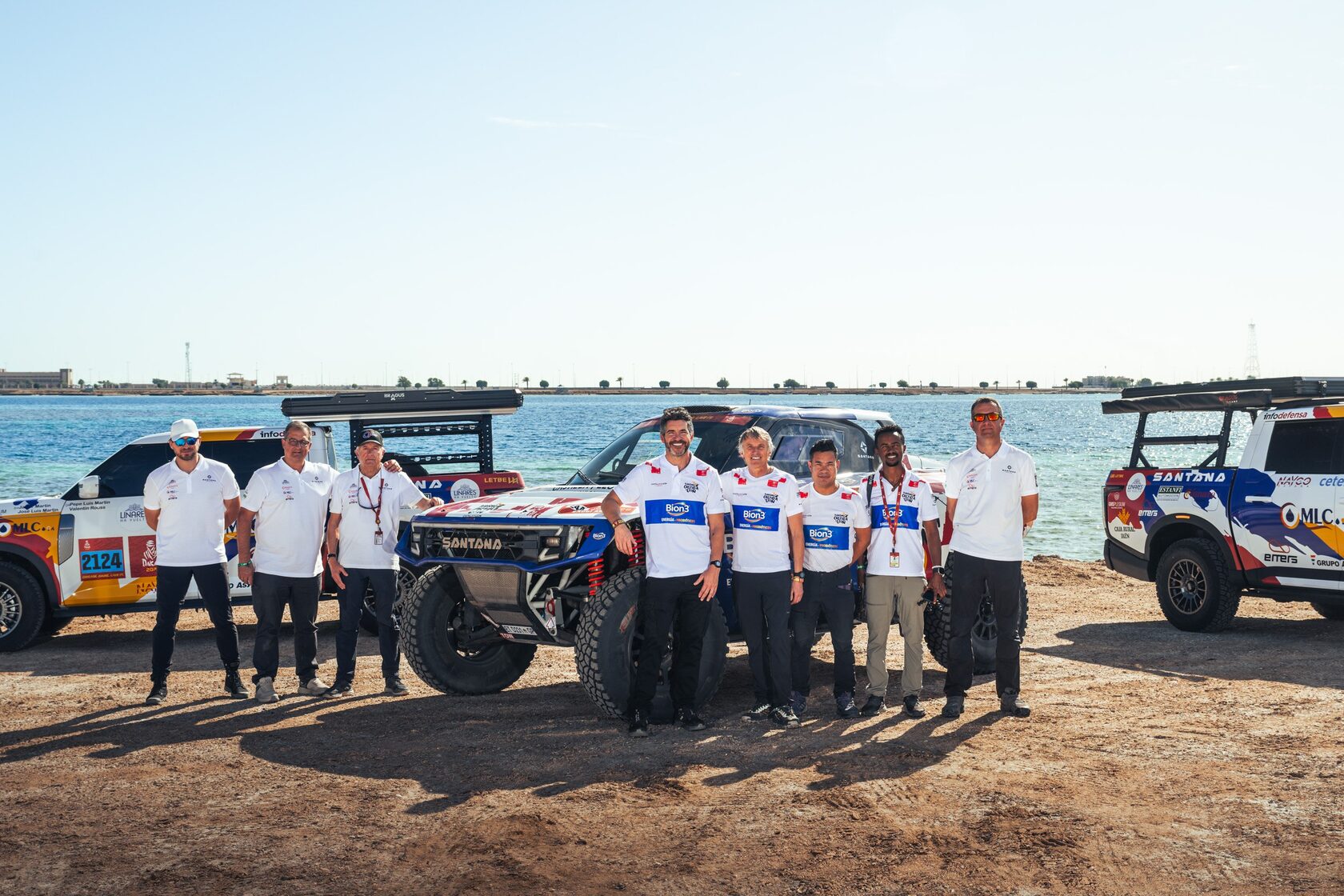
Our debut in the Rally Dakar 2026 has come to an early end. A heavy accident during stage five has forced us to withdraw our Santana Pick-Up T1+ from the race, bringing our competitive participation in this year’s Dakar to a close. Fortunately, both Jesús Calleja and Edu Blanco escaped unharmed and were able to return to the bivouac after medical checks.
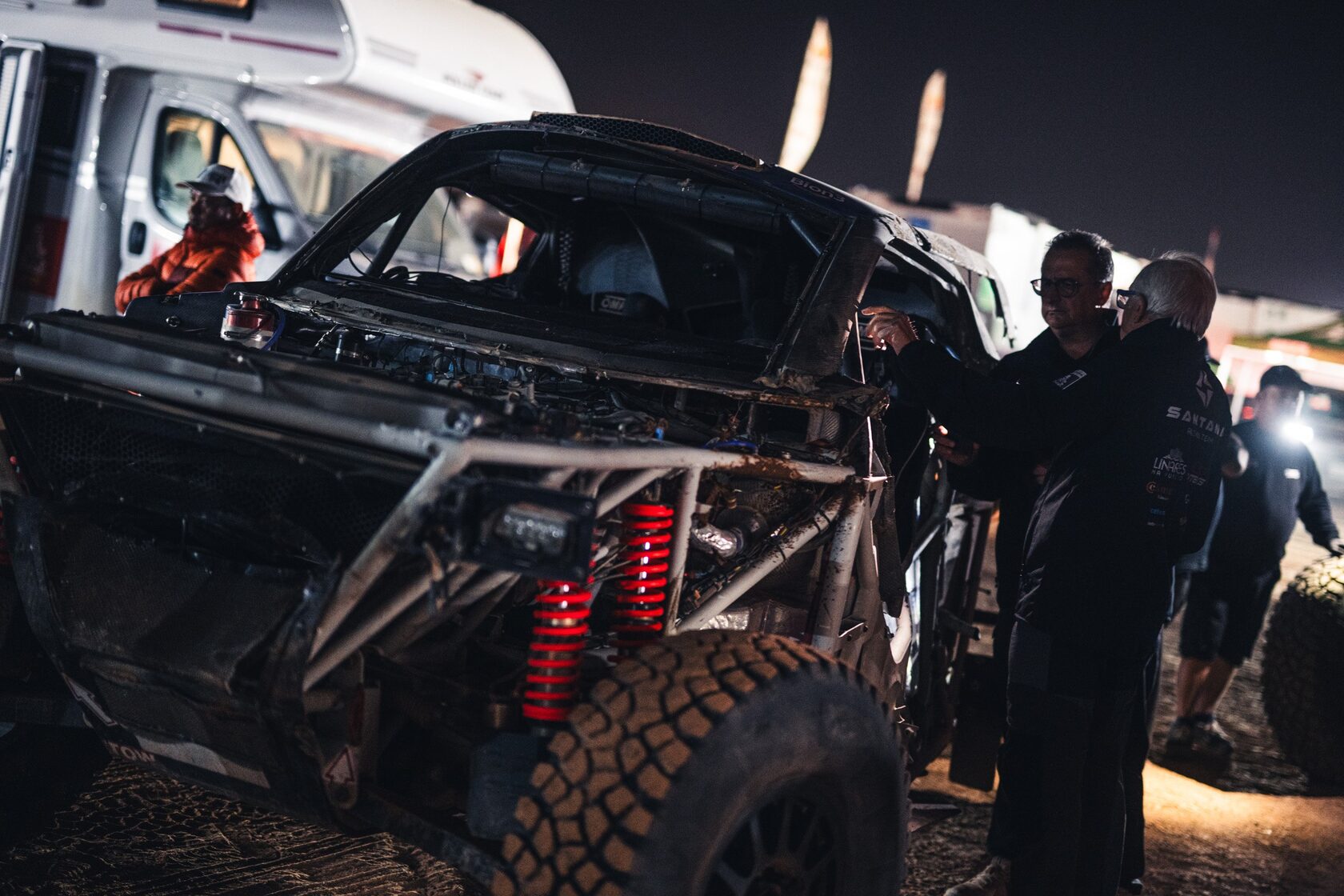
At the time of the accident, we were delivering our strongest performance so far in Dakar 2026. After finishing the previous stage in 26th position, we started stage five from 75th place in accordance with FIA regulations. Despite this, we were running at a very competitive pace and fighting our way towards the top 20 against more powerful vehicles.
This situation, which forces faster cars to overtake many slower competitors on narrow tracks with very limited visibility due to dust, has been highlighted by numerous drivers as a significant safety risk during this edition. We had already experienced it ourselves in earlier stages, having to recover more than 20 positions in stage one and over sixty in stage three.
After more than 200 kilometres of the timed section in stage five, we encountered a grade 3 hazard at high speed on a straight, which was not marked in the roadbook. With no time to react, our Santana Pick-Up T1+ rolled several times before coming to rest back on its wheels, suffering severe damage, including to the safety cage. Thankfully, both of us were able to exit the vehicle under our own power and without injuries.
Jesús Calleja commented: “I’m very happy because neither Edu nor I were hurt in the accident. We were having a really strong stage after starting far back and pushing to recover positions. We had already warned about how dangerous this regulation can be, and today we experienced it firsthand. I’d like to thank the Junta de Castilla y León and Bion3 for their support. We’ll come back stronger”.
Edu Blanco added: “We started today in 75th position and were running close to the top twenty when the accident happened. It’s a shame to end like this, but we must be grateful that we’re both fine. The safety and reliability of our Santana Pick-Up T1+ have been proven once again. We’ve learned a great deal, both from the race car and from our production pick-ups, and all that knowledge will help us continue developing better vehicles through competition”.
Dakar continues as a test laboratory
Although our race is over, our Dakar mission continues. Alongside the competition prototype, we brought two next-generation pick-ups to Saudi Arabia, the Santana 400 D and Santana 400 PHEV, which have been acting as support vehicles. Both models will remain on the ground until the end of the rally with Valentín Rouss and Antonio Molina, both part of Santana Motors.
In doing so, we continue to test our vehicles in the most demanding environment on the planet, tackling broken tracks, rocky sections and endless desert dunes. Everything we learn here will feed directly into the development of robust, reliable and technologically advanced off-road vehicles.
With competition in our DNA, it is only a matter of time before we return to the start line.
This situation, which forces faster cars to overtake many slower competitors on narrow tracks with very limited visibility due to dust, has been highlighted by numerous drivers as a significant safety risk during this edition. We had already experienced it ourselves in earlier stages, having to recover more than 20 positions in stage one and over sixty in stage three.
After more than 200 kilometres of the timed section in stage five, we encountered a grade 3 hazard at high speed on a straight, which was not marked in the roadbook. With no time to react, our Santana Pick-Up T1+ rolled several times before coming to rest back on its wheels, suffering severe damage, including to the safety cage. Thankfully, both of us were able to exit the vehicle under our own power and without injuries.
Jesús Calleja commented: “I’m very happy because neither Edu nor I were hurt in the accident. We were having a really strong stage after starting far back and pushing to recover positions. We had already warned about how dangerous this regulation can be, and today we experienced it firsthand. I’d like to thank the Junta de Castilla y León and Bion3 for their support. We’ll come back stronger”.
Edu Blanco added: “We started today in 75th position and were running close to the top twenty when the accident happened. It’s a shame to end like this, but we must be grateful that we’re both fine. The safety and reliability of our Santana Pick-Up T1+ have been proven once again. We’ve learned a great deal, both from the race car and from our production pick-ups, and all that knowledge will help us continue developing better vehicles through competition”.
Dakar continues as a test laboratory
Although our race is over, our Dakar mission continues. Alongside the competition prototype, we brought two next-generation pick-ups to Saudi Arabia, the Santana 400 D and Santana 400 PHEV, which have been acting as support vehicles. Both models will remain on the ground until the end of the rally with Valentín Rouss and Antonio Molina, both part of Santana Motors.
In doing so, we continue to test our vehicles in the most demanding environment on the planet, tackling broken tracks, rocky sections and endless desert dunes. Everything we learn here will feed directly into the development of robust, reliable and technologically advanced off-road vehicles.
With competition in our DNA, it is only a matter of time before we return to the start line.